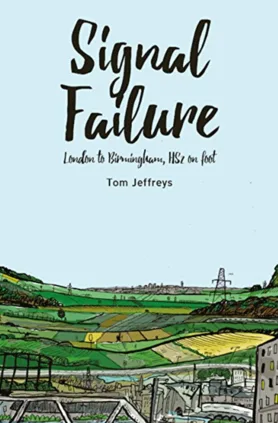
Finding an urge to colour in these gaps, Tom Jeffreys achieves something quite remarkable in Signal Failure: bringing the massive complexity of HS2 back to a human scale. He sets out to walk the route, scribed in lurid highlighter strokes across Ordnance Survey maps as a not-entirely-inaccurate approximation of how the line's critics imagine the line was planned. It should take him ten days, involve some camping out in the wild and bring him into contact with all kinds of characters who sit on the frontline of the debate along the way. It ends up being a far more complex proposition which examines the very nature of walking itself before Jeffreys finally reaches the Bull Ring.
Jeffreys is by trade a writer on art, and brings with him from that world two absolute gifts: an eye for beautiful descriptive detail which makes the waste incinerator at Calvert sound a sublime almost-equal to any view across the Chilterns, and genuine erudition which underpins his writing with detail and research. This is a surprisingly hefty book, and in the early passages where the nature of walking writers - and writing walkers - is examined, I started to feel concerned that this had backed things into a niche. However, these reflective essays are punctured by reality - errant horses, the hardships of camping, the treacherous nature of industrial cartography - which anchors them in a quest. A quest which Jeffreys self-deprecatingly feels he ultimately fails to achieve - but in unravelling the journey he introduces people who's experiences take HS2 from a conceptual diagram towards a future reality. There are the couple who didn't realise how desperate and suicidal the prospect of the line made each of them feel until they were interviewed on camera together, there is a naturalist who stands to see preciously guarded habitat riven by rails, and there is a cheesemaker who has been through this before: embracing change, diversifying to survive, revisiting the business model. Jeffreys' encounters with the wider public are perhaps more like my own when walking: suspicious, confused, somehow irritated that someone is stepping outside the normal boundaries. The walking writer is a figure of deep apprehension these days, and sometimes perhaps deservedly so.
Throughout the book, Jeffreys wonders about what he is writing - glancing off psychogeography but landing squarely between travel and nature writing on the shelf. The debate that squirms at the core of the book about nature, wilderness and human intervention finds its feet in the examination of these genre politics and I found myself genuinely intrigued by the history of older, extremely white men batting the future of the planet back and forth at length. It's important to remember to that these are, in principle at least, the people who agree we should act swiftly to save the planet! For his own part Jeffreys is, rather like me, not the kind of person who can name our flora or fauna, or who knows what's good to eat and what will kill you out there in the wilds - but his engagement with the kind of spaces we all experience, every day is challenging and inspiring.
Signal Failure is an impressive achievement - taking the walk and exploring not just the landscape and its people, but the theoretical underpinnings of grand projects like HS2 and their human and natural impact - but in a way which places us in a landscape from which we don't fully understand what we'll lose.