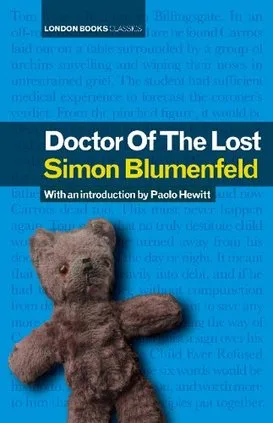
Taking it's factual cues from historical and the public records of the remarkable Barnardo, the novel fills the gaps with surprisingly effective supposition and dramatisation. Barnardo himself is sometimes unsympathetically devout, but bristles with energy and indignation too. Filled out with engaging characters drawn from his real experiences in the East End, the sharply drawn dialogue and edgy cockney wit which Blumenfeld deployed in the earlier, more controversial "Jew Boy" return. The scenes in pub and music hall resound with a reality which stems from first hand experience - as Blumenfeld was for over thirty years a writer for The Stage, in fact attaining the official record as the "oldest living columnist" during his time there. Topographically, the novel is tightly secured into the triangle of Stepney, Mile End and Limehouse - areas Blumenfeld would know well, and from which he draws rich descriptions of places, some now changed immeasurably. When the novel does stray out of this liminal zone it is a little more fanciful and blurred, echoing the strangeness of wealthy London to those who lived their entire lives in the East, and equally the horror and disbelief the upper classes felt looking in from outside.
This new edition of what is perhaps only a minor work in the London canon has been prepared by London Books in their attractive and interesting series of republished lost gems. It comes at a time when the welfare of children in society is under almost as much scrutiny as during Barnardo's lifetime. Blumenfeld lived long enough to see the man recognised and his charity flourish, and also to see many of his principles adopted as policy by successive governments. As such he makes a statement - that despite his staunchly left wing views and wish to see society become more egalitarian, he recognises the importance of Barnardo's Christian mission in changing how people regarded 'charity'. It is of course hard to regard this from a 20th or 21st century perspective - and Blumenfeld resorts to dramatising the many unsuccessful court cases brought against Barnardo to show this opposition to his philanthropy. He creates an adversary too - knowing from his pseudonymous work in Westerns and war stories, that every hero needs his anti-hero. This is perhaps where the book wanders a little too far from the truth, with a moralistic parable which is a little predictable. That said, this is otherwise a colourful tale told in a tone of typical inter-war realism.
"Doctor of the Lost" tells a fair approximation of the sometimes forgotten life of the man behind the charitable juggernaut which now has a global reach. As a novel though, it works better - with many passages of wonderfully crafted descriptive work which provide Blumenfeld with the opportunity to explore his territory in the East End. It would be terribly easy to enter a debate about how much of it is truth - but the saddest truth is that the need for a Barnardo ever arose in Victorian London.